Reviewed by Vladimir Tsirkin, Esq., Florida Personal Injury Attorney | Licensed in FL, NY, NJ, PA | Last Updated: May 2026
Haulover Inlet is one of South Florida’s most accident-prone stretches of water. Currents, congestion, weekend traffic, and inexperienced operators stack the odds against boaters who pass through. When a friend’s boat is involved in a crash, most injured passengers hesitate to file a claim because they think it means going after their friend personally. It does not. A boat accident claim is filed against the boat owner’s insurance policy, the same way a car accident claim is filed against an at-fault driver’s auto policy. The friendship stays intact, the medical bills get covered, and the insurance contract that the owner already paid for does what it was designed to do. Below: how Haulover Inlet boat accidents actually get litigated, what to do when the at-fault boat has no insurance, why Florida’s no-PIP-for-boats gap matters, and the most common boat accident questions for Hallandale Beach, Aventura, and the Intracoastal. To talk to a Florida boat accident attorney directly, see our boat accident lawyer page.
Quick Facts: Haulover Inlet and Florida Boat Accidents
- Boat insurance is not mandatory in Florida. No equivalent to car insurance laws.
- Florida PIP does not apply on the water. No automatic medical coverage like there is for cars.
- Suing a friend’s boat is suing the policy, not your friend personally. The insurer pays.
- Maritime rules + Coast Guard regulations apply. Generalist car accident lawyers often miss the federal overlay.
- Critical evidence: GPS tracks, engine data, onboard cameras, rental logs. All get overwritten fast.
- Repeat trouble spots: Haulover Inlet (currents and congestion), Hallandale-area sandbars, tight Intracoastal marina channels.
Why Haulover Inlet Is South Florida’s Repeat Boat-Accident Site
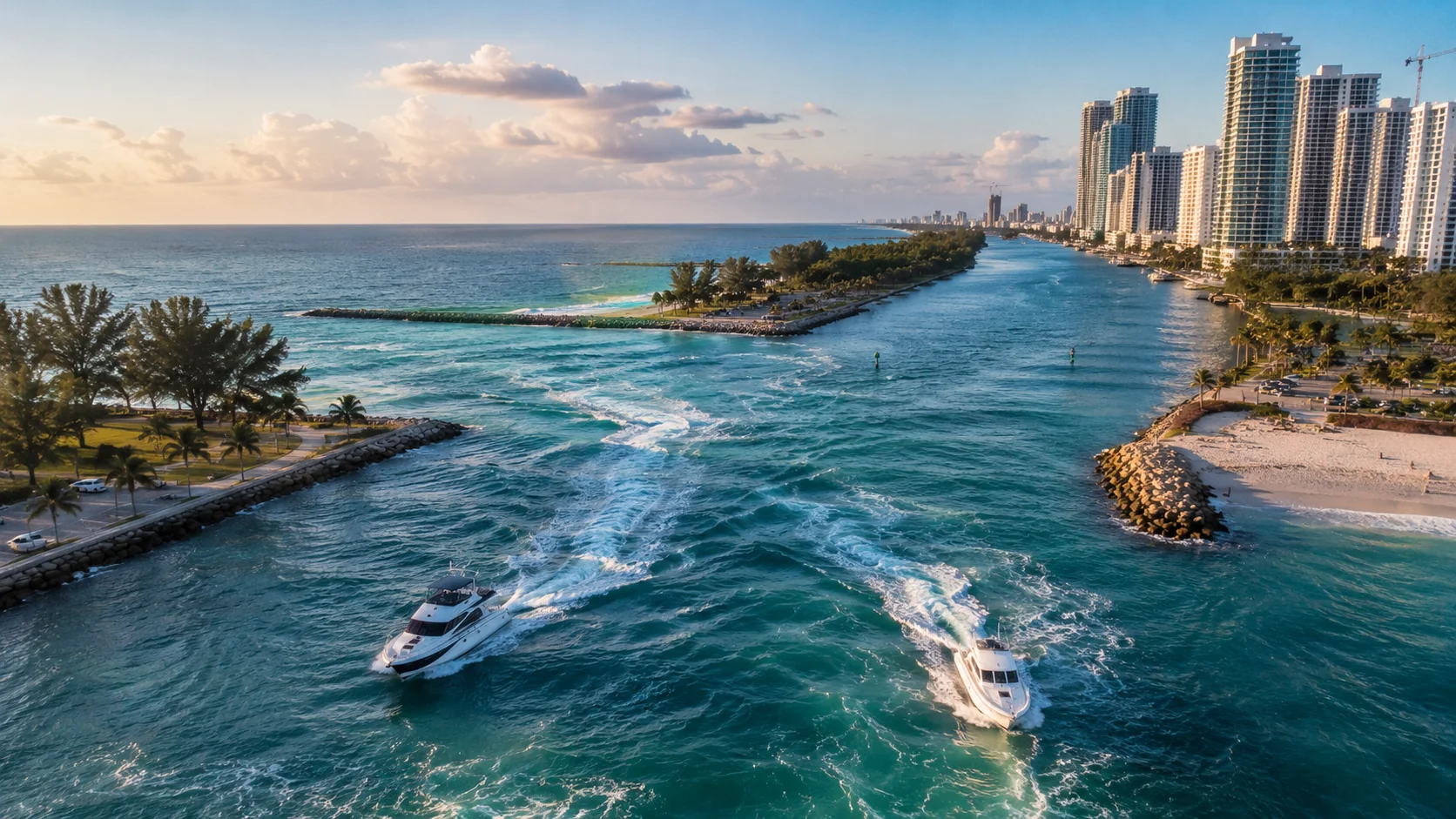
Haulover Inlet sits at the boundary between Bal Harbour and Sunny Isles Beach and connects Biscayne Bay to the Atlantic. The narrow channel, strong tidal currents, and constant weekend traffic create a chokepoint where small operator errors compound into serious crashes. Add inexperienced operators, alcohol, and high-speed wake from larger vessels, and the inlet becomes one of the most-photographed sites for boat-on-boat collisions on social media.
Per Vladimir Tsirkin: “Haulover Inlet is the obvious repeat offender due to its currents and congestion. Sandbars near Hallandale and tight marina channels along the Intracoastal are next. Speed, alcohol, and inexperience stack the odds against boaters in those areas.”
That repeat-offender status matters for case strategy: there is a body of prior incident reports, Coast Guard data, and local news coverage that establishes the inlet as a known hazard zone. Operators who fail to slow, post lookouts, or use proper navigation lights in that stretch face a steeper liability hill.
“Sue My Friend? I Don’t Want To.” (You Won’t Be.)
This is the single biggest reason injured passengers do not pursue legitimate boat accident claims. Per Vladimir Tsirkin:
“This isn’t about going after a friend. It’s about triggering an insurance contract the boat owner already paid for. No one’s writing a personal check. The insurer steps in, the relationship stays intact, and medical bills get handled. Think of it like car insurance on the water, same principle, different venue.”
Vladimir Tsirkin, Esq., Managing Attorney, Vladimir Tsirkin & Associates, P.A.
Most recreational boat owners in South Florida carry boat insurance even though Florida law does not require it. Lender requirements (when the boat is financed), marina slip rules, and basic risk management drive most owners to carry $100,000 to $1 million in liability coverage plus medical payments coverage for guests. When a passenger is injured, that policy is exactly what the carrier sells the owner: protection from personal financial exposure when something goes wrong on the water.
What Happens When the At-Fault Boat Has No Insurance
Florida’s no-mandate-for-boat-insurance regime means a meaningful percentage of boats on the water are uninsured. The good news: an experienced attorney does not stop at the boat policy. Per Vladimir Tsirkin:
“If there’s no boat insurance, I don’t stop there. I start looking elsewhere, like homeowner’s policies, umbrella coverage, rental companies, or anyone else who shouldn’t have handed over the boat in the first place. Not having insurance definitely complicates things, but most of the time there is money available. It’s just hiding under a different name.”
The hidden-coverage map for an uninsured boat:
| Source | When It Applies |
|---|---|
| Owner’s homeowner’s insurance | Some homeowner policies cover small recreational boats stored at the residence; depends on horsepower and length. |
| Personal umbrella policy | An owner’s umbrella policy may extend liability to watercraft incidents, often above an underlying boat or homeowner’s policy. |
| Rental company insurance | If the boat was rented, the rental company’s commercial liability and vessel coverage typically applies. |
| Negligent entrustment claims | If a third party (such as a charter operator or rental company) handed the boat to an unqualified operator, they may bear liability separate from the operator. |
| Marina or charter operator | If equipment failure (mooring lines, navigation lights, or required safety equipment) contributed to the crash, the marina or charter may have liability. |
The Generalist Lawyer Trap
Per Vladimir Tsirkin: “They treat boat cases like car crashes, which is borderline legal malpractice. Maritime rules, Coast Guard regulations, navigation standards, and federal overlays change the entire liability analysis. Miss that, and you leave serious money on the table.”
The differences a non-specialist tends to miss:
- Federal maritime law overlay. Some boat accident cases (particularly those involving navigable waters and commercial vessels) trigger federal admiralty jurisdiction, which has its own statute of limitations, damages framework, and procedural rules.
- Coast Guard navigation rules (Inland Rules of the Road). Right-of-way determinations on the water follow the Inland Rules, not road rules. Who had the give-way obligation depends on vessel size, speed, sail vs power, and crossing angles.
- Vessel data preservation. Modern boats record GPS, engine RPM, throttle position, and fuel data. Without a fast preservation notice, that data overwrites or is wiped during routine maintenance.
- Operator licensing and education. Florida requires the Boating Safety Education ID for operators born after 1988. Operators without it face a presumption of negligence in some cases.
Why Vladimir’s Naval and Boating Background Matters
“I didn’t pick up boating law from a book. I’ve spent real time on the water, both professionally as a former Naval Officer and personally as a boat owner. I know the local boating scene, how people actually operate out there, and how fast a fun day can go sideways. That real-world experience makes a big difference when I’m dealing with insurance companies or explaining a case to a jury.”
Vladimir Tsirkin, Esq., Managing Attorney, Vladimir Tsirkin & Associates, P.A.
That background shows up in case strategy in three concrete ways: vessel-conduct reconstruction (knowing how a boat actually behaves at speed), insurer-tactic recognition (marine insurers operate differently from auto carriers), and jury communication (translating boating concepts into ones a non-boater jury can understand).
Florida’s No-PIP-on-the-Water Gap
Florida’s Personal Injury Protection (PIP) coverage, which provides $10,000 of automatic medical coverage for car accidents regardless of fault, does not apply to boat accidents. There is no equivalent statute. Injured boaters have to rely on:
- The at-fault boat owner’s liability coverage.
- The injured passenger’s own health insurance (which may have subrogation rights to be repaid from the eventual settlement).
- The injured passenger’s auto-policy MedPay (sometimes applies to land-side incidents at the marina).
- Coast Guard or marina emergency response (does not cover ongoing medical bills).
The takeaway: the right insurance policy must do the work. Identifying it quickly is what protects an injured passenger from a six-figure medical bill.
Why Choose Vladimir Tsirkin and Associates
- Former Naval Officer and personal boat owner. Direct, real-world fluency in maritime concepts that generalist personal injury lawyers often miss.
- Multi-state licensure (FL, NY, NJ, PA) for cases involving travel between the Northeast and South Florida marinas.
- Specific experience with Haulover Inlet, Intracoastal, and Hallandale-area boat accident cases.
- Direct attorney access from first call through settlement or trial.
- Hospital and home visits for injured clients.
- Contingency fee model: no fee unless we win.
“Boating cases reward precision, speed, and maritime fluency. That’s where we operate, and that’s how clients win.”
Vladimir Tsirkin, Esq., Managing Attorney, Vladimir Tsirkin & Associates, P.A.
Free Boat Accident Case Evaluation
Frequently Asked Questions
If I sue my friend’s boat insurance, will my friend have to pay out of pocket?
Almost never. The claim is filed against the owner’s marine insurance policy, and the insurer pays. The owner’s only out-of-pocket exposure is whatever deductible the policy has, plus any award amount above the policy limit (which is rare for serious-injury cases involving fully-insured boats).
What if I signed a liability waiver at a rental company?
A waiver does not kill the case. Per Vladimir Tsirkin: “Papers don’t excuse unsafe conduct.” Florida courts disfavor blanket waivers for gross negligence, recklessness, or violations of safety statutes. A careful attorney audit of the waiver language and the operator’s conduct is the right starting point.
I didn’t call the police after the crash. Is it too late?
Almost never too late. Per Vladimir Tsirkin: “Lack of a report makes the case harder, not impossible. We build claims with witness statements, marina records, vessel damage, GPS data, and medical timelines. Delay hurts, but it doesn’t kill a valid claim.”
What if the passenger had been drinking or wasn’t wearing a life jacket?
It complicates the case but does not automatically defeat it. Florida’s modified comparative-negligence rule allows recovery if the injured person was less than 50 percent at fault. The focus shifts to what actually caused the injury: operator mistakes, safety violations, and bad decisions by the person at the helm.
What evidence disappears first in a boat accident case?
Electronic data. GPS tracks, engine data, onboard cameras, rental logs. These get overwritten fast. Per Vladimir Tsirkin: “Calling early isn’t ‘nice to have’; it’s mission critical.”
What does it cost to hire a Florida boat accident attorney?
Nothing upfront. Vladimir Tsirkin and Associates work on a contingency basis. You pay nothing unless we win, and the firm fronts case costs.
Legal Disclaimer: This article is for informational purposes only and does not constitute legal advice. Consult a qualified attorney for guidance on your specific situation. Past results do not guarantee future outcomes.