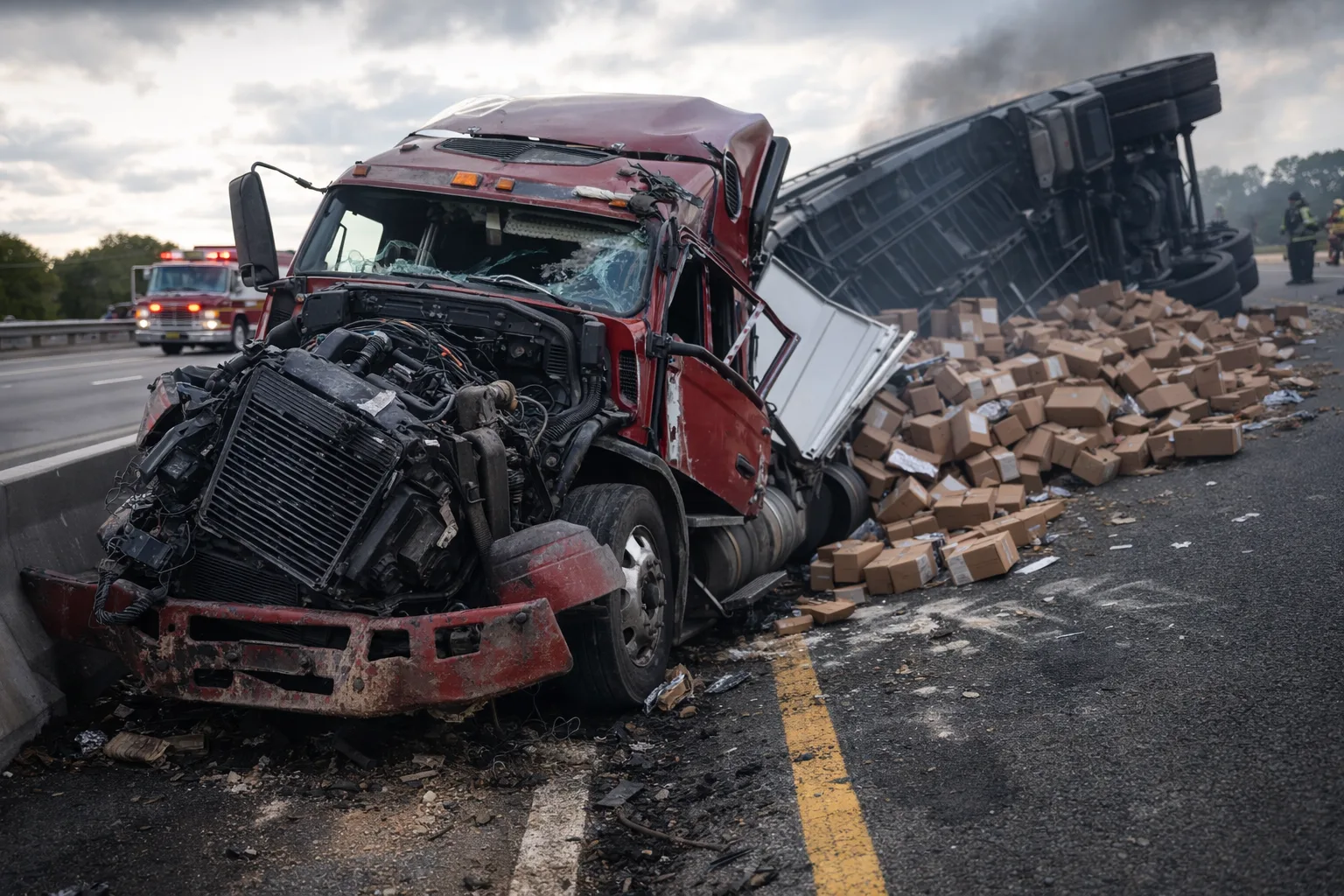
The most common causes of truck accidents are driver fatigue from hours of service violations, distracted driving, speeding to meet unrealistic deadlines, improper cargo loading, inadequate vehicle maintenance, and impaired driving. In most cases, the trucking company shares responsibility because they pressure drivers to cut corners or fail to maintain their fleet properly.
Understanding what caused your truck accident matters because the cause determines who is liable and how much compensation you can recover. When a trucking company violates federal safety regulations or puts profits ahead of public safety, that negligence becomes evidence that strengthens your case.
Driver Fatigue and Hours of Service Violations
Driver fatigue is the leading cause of truck accidents. An exhausted driver behind the wheel of an 80,000-pound vehicle is a deadly threat to everyone on the road.
Federal law limits how long truck drivers can operate precisely because fatigue kills:
- Drivers may not exceed 11 hours of driving after 10 consecutive hours off duty
- They cannot drive beyond the 14th hour after coming on duty
- They must take a 30-minute break after 8 hours of driving
These rules exist because studies show that driver alertness drops dramatically after extended periods behind the wheel. A fatigued driver has slower reaction times, impaired judgment, and may even fall asleep at the wheel.
The problem is that trucking companies often pressure drivers to violate these limits. Delivery deadlines, compensation structures that reward speed over safety, and unrealistic schedules push drivers to falsify logs and keep driving when they should be resting.
Since 2017, most commercial trucks must use electronic logging devices that automatically record driving time. But some drivers and companies still try to cheat the system by using multiple driver identities, disconnecting devices, or misclassifying driving time.
When a truck driver causes an accident while exceeding legal driving limits, that violation is powerful evidence of negligence. The trucking company cannot claim the crash was unforeseeable when their own records show they broke the law. Learn more about federal truck accident laws and regulations.
Distracted Driving
Distracted driving is dangerous in any vehicle, but in an 80,000-pound truck traveling at highway speeds, even a few seconds of inattention can be catastrophic.
Commercial truck drivers face constant distractions: cell phones, GPS devices, dispatch communications, eating, adjusting the radio, and simple daydreaming. When a driver looks away from the road, they may not see traffic slowing ahead, a vehicle in their blind spot, or a hazard requiring evasive action.
The physics make this deadly. A fully loaded semi-truck traveling at 65 miles per hour needs approximately 525 feet to stop, nearly the length of two football fields. If the driver is distracted and reacts even one second late, that adds another 95 feet before braking even begins.
Cell phone records, dashcam footage, and witness statements can prove distracted driving after an accident. A truck accident lawyer knows how to subpoena these records before the trucking company can delete them.
Speeding and Reckless Driving
Speeding is a factor in a significant percentage of fatal truck accidents. Truck drivers speed for one primary reason: pressure from their employers to meet delivery deadlines.
The trucking industry’s compensation structure often rewards speed. Drivers paid by the mile or by the load have financial incentives to drive faster and longer. Trucking companies that promise rapid delivery times create schedules that cannot be met without speeding or violating hours of service rules.
When a speeding truck loses control, the consequences are devastating. Higher speeds mean longer stopping distances, more severe impacts, and greater likelihood of rollovers and jackknife accidents.
The truck’s electronic data recorder, often called the black box, captures speed data from the moments before and during a crash. This evidence can prove the driver was exceeding the speed limit or driving too fast for conditions. Preserving this data requires immediate action, as it can be overwritten within days.
Improper Cargo Loading
Improperly loaded or secured cargo causes truck accidents in several ways. Overloaded trucks have longer stopping distances and put excessive strain on brakes and tires. Unbalanced loads make trucks harder to control, especially during turns or lane changes. Unsecured cargo can shift during transit, causing the truck to roll over or jackknife.
Federal regulations specify exactly how different types of cargo must be secured, including the number, type, and strength of tie-downs required. The shipper, the trucking company, and the driver may all share liability when cargo-related violations cause accidents.
Cargo that falls from trucks creates additional hazards. Other drivers must swerve to avoid debris, potentially losing control or colliding with other vehicles. Proving cargo-related negligence requires investigating the loading process, reviewing weight tickets, and examining whether securement met federal standards.
Inadequate Truck Maintenance
Commercial trucks require rigorous maintenance to operate safely. Brakes, tires, steering, suspension, lights, and coupling devices must all be inspected and maintained according to federal regulations.
When trucking companies cut corners on maintenance to save money, mechanical failures cause accidents. Common maintenance-related failures include:
| Failure Type | Why It Is Dangerous |
|---|---|
| Brake failure | Trucks need 525+ feet to stop at highway speed, failed brakes make stopping impossible |
| Tire blowouts | Worn or improperly inflated tires can cause loss of control at high speed |
| Steering failures | Prevents drivers from maneuvering to avoid hazards |
| Lighting failures | Makes trucks invisible to other drivers at night |
| Coupling failures | Trailers can separate and jackknife across multiple lanes |
Federal regulations require pre-trip and post-trip inspections by drivers, annual inspections by qualified mechanics, and documentation of all maintenance and repairs. When a trucking company’s records show they skipped inspections or ignored known defects, they cannot claim a mechanical failure was unforeseeable.
Impaired Driving
Truck drivers are prohibited from operating under the influence of alcohol or drugs. The blood alcohol limit for commercial drivers is 0.04%, half the limit for regular drivers. Drivers are also prohibited from using marijuana and other controlled substances, even in states where recreational use is legal.
Federal regulations require drug and alcohol testing before employment, after accidents, upon reasonable suspicion, randomly during employment, and when returning to duty after a violation. Trucking companies that fail to conduct required testing, or that ignore positive results, can be held liable when impaired drivers cause accidents.
After an accident, post-crash drug and alcohol testing should occur promptly. When trucking companies delay testing or handle samples improperly, it raises questions about what they are trying to hide.
Trucking Company Negligence
Behind many truck accidents is a trucking company that prioritized profits over safety. While the driver may have made the final mistake, the company often created the conditions that made that mistake inevitable.
Trucking company negligence takes many forms: negligent hiring when companies fail to verify driver qualifications, negligent supervision when companies fail to monitor driver behavior, unrealistic schedules that pressure drivers to speed and skip rest breaks, inadequate training, failure to maintain vehicles, and failure to enforce drug testing.
“General practitioners often miss federal trucking law nuances, underestimate the need for expert reconstructionists, or fail to subpoena telematics and GPS data promptly. Without specialized knowledge, crucial liability evidence can vanish within weeks.”
How Proving the Cause Strengthens Your Case
Understanding what caused your truck accident is not just about satisfying curiosity. The cause determines who is liable and can significantly increase your compensation.
When you can prove the trucking company violated federal safety regulations, you do not just show they were careless. You show they broke specific laws designed to prevent exactly the type of accident that injured you. This can establish negligence as a matter of law, rather than leaving it to a jury to decide.
Certain violations may also support punitive damages. If a trucking company knowingly put an impaired driver on the road, or deliberately falsified maintenance records, a jury may award additional damages to punish that conduct and deter others from similar behavior.
In one case handled by Vladimir Tsirkin, a professional truck driver was seriously injured after colliding with a truck stopped in the middle of a dark roadway. Initial reports blamed the client. But investigation revealed the stopped truck’s taillights were off due to a malfunction. That discovery, proving inadequate maintenance caused the accident, turned the case around and led to a substantial settlement.
Vladimir Tsirkin Investigates Every Truck Accident Cause
When you hire Vladimir Tsirkin and Associates, the investigation begins immediately. The firm sends evidence preservation letters to secure black box data, dashcam footage, driver logs, maintenance records, and driver qualification files before the trucking company can alter or destroy them.
A forensic specialist may be retained within 24 hours to document skid marks, damage angles, and road conditions at the crash scene. The firm works with accident reconstructionists, medical specialists, DOT compliance experts, and financial analysts to build comprehensive cases proving exactly what caused your accident and who is responsible.
“The single biggest misstep is failing to preserve evidence. A client’s first moves should be: seek medical care and contact an attorney.”
• Vladimir Tsirkin, Esq.
Vladimir Tsirkin is licensed in Florida, New York, New Jersey, and Pennsylvania. Whether you were injured in Hallandale Beach, traveling through Broward County, or visiting from the Northeast, he can handle your case.
Wondering about the financial side? Learn how much an accident lawyer costs and how long settlements take.
Call 800-99-CRASH or (305) 831-4333 for a free consultation. No fee unless we win. Request a free case evaluation online.
Frequently Asked Questions About Truck Accident Causes
Who is at fault in most truck accidents?
In most truck accidents, the truck driver, the trucking company, or both share fault. Common causes like driver fatigue, speeding, and inadequate maintenance typically result from trucking company policies that prioritize speed over safety. While individual driver errors cause crashes, companies that pressure drivers to violate safety rules share liability.
How do you prove what caused a truck accident?
Proving the cause requires preserving and analyzing evidence including the truck’s electronic data recorder (black box), electronic logging device records, driver qualification files, maintenance records, dashcam footage, and dispatch communications. Accident reconstruction experts can analyze physical evidence to determine speed, braking, and impact dynamics. This evidence must be preserved immediately before it is overwritten or destroyed.
Can I sue the trucking company if the driver caused the accident?
Yes. Trucking companies can be held vicariously liable for their drivers’ negligence. They can also be held directly liable for negligent hiring, inadequate training, unrealistic schedules, failure to maintain vehicles, and failure to enforce safety policies. In many cases, the trucking company has more insurance coverage and assets than the individual driver.
What is a jackknife accident?
A jackknife accident occurs when a truck’s trailer swings out to form a 90-degree angle with the tractor, resembling a folding knife. This typically happens when the driver brakes suddenly and the trailer’s momentum carries it forward while the tractor slows. Jackknife accidents are extremely dangerous because the trailer can sweep across multiple lanes of traffic.
What is a rollover accident?
A rollover accident occurs when a truck tips onto its side or roof. Commercial trucks are susceptible to rollovers due to their high center of gravity and heavy loads. Rollovers can be caused by speeding through curves, sudden steering maneuvers, improperly loaded cargo, or road conditions. These accidents are among the most deadly truck accident types.
Legal Disclaimer: This article is for informational purposes only and does not constitute legal advice. Every case is unique. Contact our office to discuss your specific situation.